Video Marketing for Dentists — What Actually Brings In Patients
Most dental practices either avoid video entirely or post clips that look like everyone else’s. Both choices cost patients. Here is what works instead.
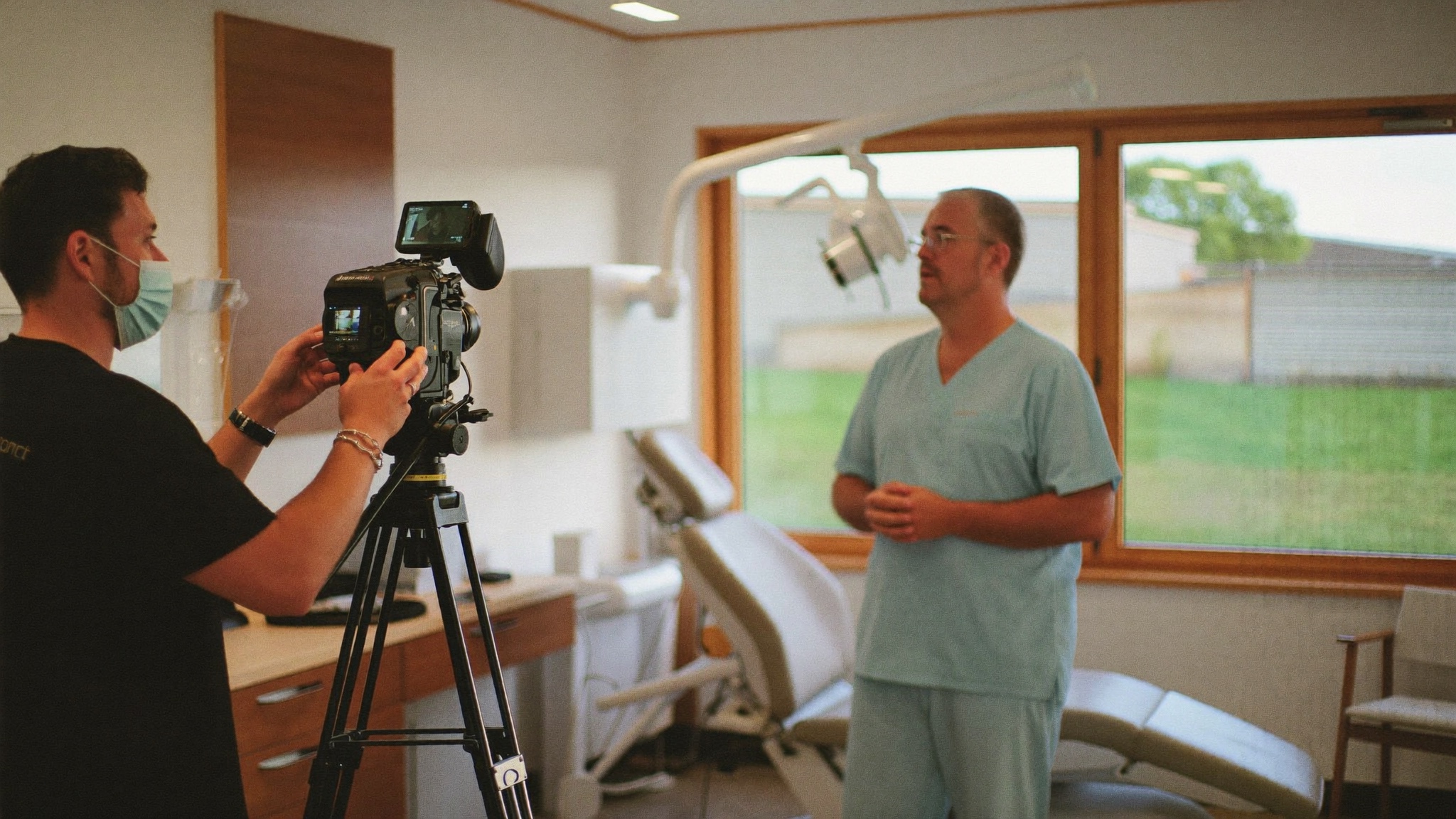
Patients choose a person, not a procedure.
Nobody searches for a crown because they love dentistry. They search because something is wrong, they are anxious about it, and they are about to let a stranger work inside their mouth. The real question a new patient is asking is not "who offers implants near me" — it is "who can I trust with this."
Text cannot answer that question. Photos barely can. Video answers it in seconds: how the dentist talks, how the team treats people, what the rooms actually look like. A patient who has watched two minutes of the practice on camera walks in feeling like a returning visitor, not a stranger.
The four videos that do the work.
A dental practice does not need a content calendar with thirty reels a month. It needs four pieces done properly. A practice film: ninety seconds of the space, the team and the standard of care, shot in real light. A dentist introduction: the doctor speaking plainly about how they work and what they refuse to compromise on. A treatment walk-through: what actually happens during an implant or veneer appointment, told calmly to remove fear. And patient stories: real people explaining what changed for them.
These four cover every stage of the decision. The practice film builds familiarity, the introduction builds trust in the person, the walk-through removes fear, and the patient story provides proof. Everything else is a remix of these.
Why most dental video fails.
The usual dental video is either a stock montage — drone shot of the building, handshake, smiling model with perfect teeth that were never treated in that office — or a trend reel where the team dances in scrubs. The first says nothing. The second says the wrong thing, especially to the patient about to spend five figures on a full-mouth restoration.
The failure is not effort. It is direction. The practice films what is easy to film instead of what the anxious patient actually needs to see: real spaces, a real doctor speaking like a human being, and real outcomes presented honestly.
Quality is read as competence.
Patients cannot evaluate clinical skill. They have no way to compare your implant technique to the practice down the street. So they judge by proxy: the website, the photography, the video, the way the front desk answers. Visual quality becomes a stand-in for clinical quality — unfair, but universal.
A calm, well-lit, well-edited film signals the same things as a clean treatment room: this practice controls details. A shaky phone clip with bad audio signals the opposite, no matter how good the dentistry is.
Where the videos go to work.
The practice film belongs at the top of the homepage and pinned on Google Business and Instagram. The dentist introduction sits on the about page and in the booking confirmation email, so every new patient meets the doctor before the visit. The treatment walk-throughs live on the service pages where anxious patients are deciding. Patient stories run as ads and follow-ups, because proof converts the undecided.
Used this way, one production day keeps working for years. The videos do not chase an algorithm. They sit exactly where the decision happens and quietly raise the value of every appointment booked.